Ask a commodity trading firm what runs their business and most will say the ERP. Ask what actually keeps the desk alive day to day and the honest answer is usually a spreadsheet somebody built years ago that nobody's allowed to touch anymore.
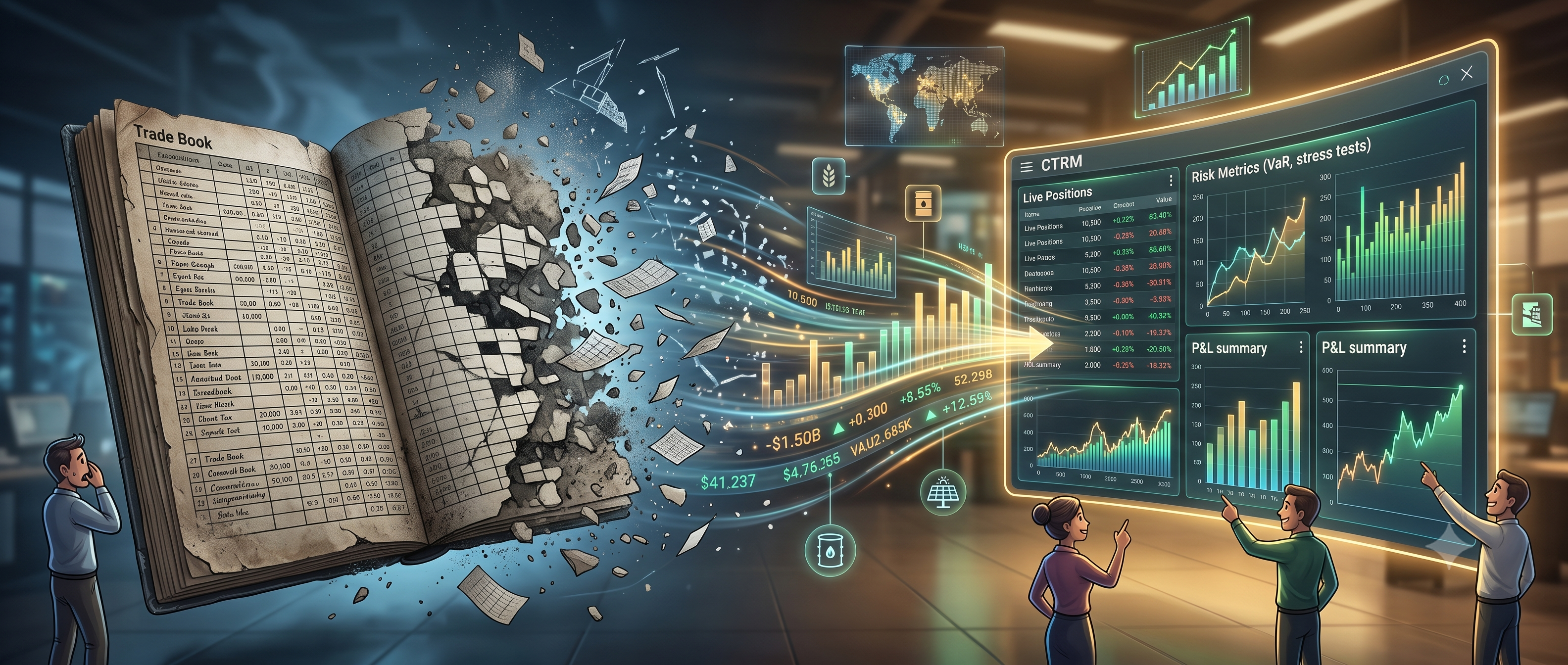
That's the real system of record for most trading desks I've walked into. Not the ERP. Not even the CTRM, if they have one and aren't using it properly. A spreadsheet, maintained by one person, that everyone quietly depends on and nobody wants to be the one who breaks.
This is the part nobody says out loud in vendor pitches: the problem isn't that firms lack technology. It's that they've built their entire risk posture on the two systems least equipped to carry it.
ERP tells you what happened. Excel tells you what one person remembers. Neither tells you what's about to happen.
An ERP is excellent at its actual job. General ledger, procurement, financial consolidation, statutory reporting. None of that is in question.
But an ERP has no native concept of a forward position. It doesn't know what your net exposure looks like if crude moves two dollars in the next hour. It records a transaction after the fact. It was never built to price risk on something that hasn't settled yet, which is the entire job of a trading desk.
So finance keeps the ERP as the system of truth for the business, and the desk keeps Excel as the system of truth for the trade book, because Excel is fast, flexible, and doesn't require a change request to add a column. Which is exactly the problem. Flexibility with no audit trail is how a single fat-finger entry turns into a multi-million dollar exposure nobody notices until settlement.
I've seen this exact failure play out. A hedge ratio calculated correctly, entered into the wrong cell, propagated silently through three linked tabs, and discovered only when the position report didn't reconcile at month-end. Not a system failure. A spreadsheet doing exactly what spreadsheets do.
CTRM exists precisely to close that gap. Real-time position management. Mark-to-market that updates the moment a trade hits the book, not at month-end. Value-at-risk that recalculates continuously instead of getting rebuilt from scratch in a new tab every quarter. This isn't a nice-to-have layered on top of ERP and Excel. It's the piece actually built for the job the desk is doing.'
Why CTRM deserves to be the primary system, not the backup one
Most firms treat CTRM as an add-on. Something you bolt onto the ERP once the spreadsheet finally breaks badly enough. That's backwards, and it's the reason so many CTRM implementations underdeliver: the desk never actually moves its real trust into the new system. They keep the spreadsheet running "just in case" for the first six months, then the first year, then indefinitely, and the CTRM becomes a reporting layer instead of the operational core it was bought to be.
CTRM Centre frames true commodity management as ERP plus CTRM, and that's the right mental model, but it only works if CTRM is doing the heavy lifting on the operational and risk side, not sitting underneath the ERP as a glorified data feed.
The ERP should own the financial truth. CTRM should own everything upstream of that: trade capture, position, risk, logistics, the vessel scheduling and terminal coordination and quality specs that an ERP has zero framework for and Excel was never designed to track past a certain volume.
The firms getting this right aren't the big integrated majors, interestingly. They already have CTRM, usually a legacy platform now being re-platformed onto cloud infrastructure. The sharper signal is mid-size firms, a lot of them in APAC, hitting real volume and complexity for the first time and discovering their spreadsheet-based trade book has quietly become the single biggest operational risk in the business. For them, the decision isn't "should we add CTRM." It's "the cost of staying on Excel just became higher than the cost of implementing this properly."
Where AI is actually making CTRM more efficient, not just more impressive
This is where it gets genuinely useful, and it's a different conversation than the one happening on LinkedIn about AI "revolutionizing trading."
The honest 2026 read, and this lines up with what Commodity Technology Advisory published in their latest industry report, is that the hype-versus-reality debate on AI in this space is over. AI is here to stay. But the value isn't showing up as some autonomous trading agent making decisions. It's showing up inside CTRM itself, making the system firms already have work faster and cleaner.
Three places specifically. Forecasting and demand prediction, feeding better inputs into the risk models CTRM already runs. Reconciliation, the tedious daily matching of trade confirmations, invoices, and settlement data that used to eat hours of an ops analyst's day and now gets flagged automatically, exceptions surfaced instead of buried. And report generation, turning what used to be a half-day manual compilation into something that happens in the background while the analyst does something that actually needs judgment.
Operations is quietly the function with the most AI upside right now, and it's the least glamorous one. Coordinating vessels, terminal slots, inspectors, and the document trail behind a single physical delivery is repetitive, rules-based, and exactly the kind of complexity AI-assisted automation handles well inside a CTRM system. That's a less exciting story than "AI trading agent." It's also the one actually shipping in production.
What's not there yet: autonomous AI trading decisions, the thing most posts imply is already standard. It isn't. Risk analytics and forecasting are mature. Autonomy is not.
The efficiency gain only shows up if the data's already inside CTRM
Here's the catch, and it's the reason "just add AI" is bad advice on its own. AI inside CTRM is only as good as what's feeding it. A firm still running its real trade book in Excel and only syncing summary numbers into CTRM once a week isn't going to see any of this efficiency. The AI has nothing clean to work with.
This is the honest version of what gets called an "AI adoption barrier." It's rarely scepticism. It's data maturity. Firms whose trade capture is still fragmented across spreadsheets can't reconcile automatically, because there's no single, trusted feed to reconcile against. The AI reconciliation feature works. The underlying process feeding it doesn't exist yet in a form the AI can use.
Which is really an argument for CTRM adoption first, AI second. Get trade capture, position data, and reconciliation living inside CTRM as the actual system of record. The AI efficiency gains follow naturally once that foundation exists, because the system finally has consistent, structured data to learn from instead of three versions of the truth spread across finance, ops, and someone's personal spreadsheet.
What's changed in the buying conversation ?
Clients used to ask vendors whether their platform "has AI." Now the question has split into two: what does it actually do inside the core CTRM functionality, specifically, and what's the governance framework around it, who's accountable when a forecast is wrong.
That second question is new in the last two years and it's now standard in serious procurement conversations. It also tracks with a broader shift: firms are done treating CTRM as optional infrastructure they'll get to eventually. It's the essential layer, the same way nobody debates whether you need accounting software anymore. The question has moved from should we to which one, and how do we make sure it's actually the system we rely on instead of the one we bought and half-adopted.
The way forward
Stop treating CTRM as the backup to Excel and the accessory to ERP. Make it the operational core it was built to be, let ERP keep owning the financial ledger, and only then start asking what AI can do inside it.
Firms trying to skip straight to AI while still running their real trade book in spreadsheets are optimizing the wrong layer. The ones who move their actual trust, not just their reporting, into CTRM first are the ones who'll get real efficiency out of AI when it lands. Everyone else is going to keep discovering their exposure the expensive way: after the fact, in a cell nobody double-checked.

Written by
Bivas Mishra
Solid piece, though I'd push back on one part. In our implementation, getting CTRM and SAP to agree on the same numbers was the harder problem, not moving traders off Excel. That integration took longer than the actual migration. Curious whether that's common or whether we just picked an unusually stubborn ERP to reconcile against.
The point about CTRM becoming a reporting layer instead of the operational core is the one I see most often, and it's rarely a technology failure it's usually that trade capture workflows in CTRM are more rigid than the spreadsheet they replaced, so traders route around it under deadline pressure. The fix isn't more governance memos, it's making the CTRM entry flow as fast as the spreadsheet was, or the just in case habit never dies.
Agree with the sequencing argument but Id flag a practical wrinkle firms often dont get a clean CTRM first then AI phase theyre asked to show AI driven efficiency to justify the CTRM spend in the first place So the reconciliation gets half fed data anyway and the AI feature gets blamed for underperforming when its really a data maturity problem exactly as you said Might be worth a follow up on how to sell that sequencing internally when finance wants the AI headline in year one.